
The Digital Periegesis launch
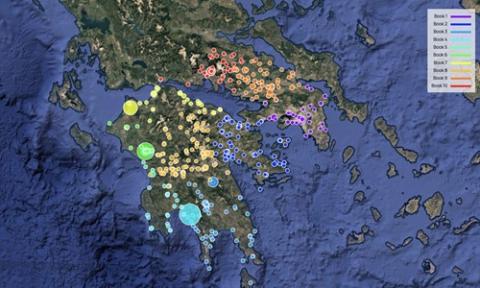
Sometime in the second century CE, Pausanias of Magnesia (in modern-day Türkiye) wrote the Periegesis Hellados or Description of Greece. Documenting ‘the sights worth seeing’ (Pausanias 1.39.3) on a tour of the Greek mainland, this text offers a uniquely rich first-hand account of ancient Greece’s built environment, down to its temples, statues and paintings. Yet spatial description characterises only one aspect of this narrative: Pausanias also relates ‘accounts’ (1.39.3) that provide histories to many of the places through which he moves and the objects he describes.
The Digital Periegesis represents the first concerted effort to capture this information in a comprehensive and consistent manner, and publish the results for general use according to Linked Open Data FAIR principles. Running since 2017, with funding from the Marcus and Amalia Wallenberg Foundation and the Swedish Research Council, the Digital Periegesis also articulates best practice for using the latest digital technology to map historical texts, and cultural heritage more generally, while as far as possible prioritising reuse of data, standards and tools. In raw data terms, the Digital Periegesis has annotated: 4225 places, 1762 objects/artworks, 3882 people/groups, 161 cited ancient texts, and (still in progress) over 1000 events and some 1500 logoi recorded by Pausanias. The team began its work using the open-source annotation tool, Recogito to capture entities and concepts from the Greek text along with basic relations. These annotations were transformed to fully linked data using the Nodegoat platform. publish them in structured formats, and visualise them using maps or network graphs; and the open-source software library, Peripleo, for visualising text and map alongside each other. To ensure optimal data discovery, interoperability and reuse, the Digital Perigesis team have liaised extensively with leading experts in the field of LOD under the aegis of the Pelagios Network, including MANTO and Pleiades, and have contributed widely to Wikidata itself. All of our data have unique and stable identifiers (URIs), linked to external authorities where possible, are free to download as CSV or GeoJSON files, and can be visualised in various in-built maps.
In this way, as much as it being a project with specific research questions and aims, the Digital Periegesis is contributing to the Public Humanities, by publishing data that can be openly accessed and reused, developing methods that can be reproducible, and helping to build tools that are open source and interoperable within the broader LOD ecosystem.
The Team The Digital Periegesis team are: Anna Foka (Uppsala University), Elton Barker (The Open University), Kyriaki Konstantinidou (Institute for Mediterranean Studies, Swedish Institute at Athens), Linda Talatas (Swedish Institute at Athens), and Brady Kiesling (ToposText, Swedish Institute at Athens). For the Digital Periegesis website wizardry: Fotis Theodoridis (Södertörn). For Nodegoat expertise: Pim van Bree and Geert Kessels. Other colleagues who have joined us along the way include: Cenk Demiroglou and Kajsa Palm (Umeå University); and Nasrin Mostofian, Vasiliki Tsoumari and Alexandros Kokkinides (Uppsala University).
The Digital Periegesis was made possible by funding from the Marcus and Amalia Wallenberg Foundation and the Swedish Research Council.
Request your prospectus

Explore our qualifications and courses by requesting one of our prospectuses today.
Are you already an OU student?


Explore

Undergraduate
Postgraduate
Policy
-
Follow us on Social media
-


