
Historian Sara Wolfson wins British Academy/Leverhulme Research Grant
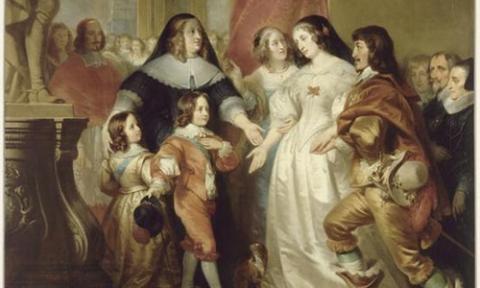
Sara Wolfson, Staff Tutor and Senior Lecturer in History has been awarded a BA/Leverhulme Small Research Grant to explore the royalist court in exile of Queen Henrietta Maria, consort to King Charles I and mother of King Charles II. In July 1644, days after giving birth to her eighth child in Exeter and fearing capture from parliamentary forces, Henrietta Maria was forced to flee England to set up court in France during the Wars of the Three Kingdoms (1639-1653) and Interregnum (1649-1660). Sara’s project examines royalist exiles at Henrietta Maria’s French court and will reconstruct, for the first time, the queen’s full household service in exile. The study will show how royalist exiles in Paris were actively involved in royal service, in court family networks and in political, foreign, domestic and religious politics and patronage on behalf of themselves and the Stuart monarchy.
Underpinning Sara’s study is the recent continental turn in Stuart history, which she argues shows the futility of studying civil war and royalism within the confines of national politics and Anglo-centric boundaries. Sara argues that ‘it is important to study the royalist court in exile in Paris to understand fully Stuart politics, which were shaped by dynastic and foreign relations, as well as by domestic events in the Three Kingdoms’. Sara points out that historians have neglected the study of Henrietta Maria and her court in exile in favour of a concentration on the literary and political activities of exiles at the courts of the queen’s eldest daughter, Princess Mary of Orange; her sister-in-law, Elizabeth of Bohemia; and, her son, Charles II. Unhelpful to the study of Henrietta Maria’s court in 1640s and 1650s is the general dependency of Stuart scholars on English archives and royalism within Britain, which Sara argues has caused an ‘Anglo-centric approach to the Wars of the Three Kingdoms’. Consequently, Sara’s project will rethink the queen’s role during this period as pivotal to raising support for the Stuarts in Europe.
A key element of the study will examine the framework of values and perceptions according to which ‘exile’ as a construct was understood by historical figures. Modern day definitions produced by scholars to define present day migrants, refugees and immigrants will not feature in this analysis, but Sara’s project will cautiously apply contemporary understanding of the psychological impact of displacement onto the experience of the seventeenth century exile. Interpreting royalist exiles in Paris through the lens of trauma and the history of emotions will create a fuller understanding of the lived in experience of those individuals who sought refuge at the court of Henrietta Maria. Sara’s project approaches royalism and exile through the various prisms of court studies, displacement and geography. Indeed, royalists who sought refuge at the court of Queen Henrietta Maria during the Wars of the Three Kingdoms and Interregnum were part of an international exchange of ideas, networks, intrigue and negotiation over policy. Through these various links, exiles were connected not only to other exiled Stuart courts of Europe, but also to familial ties back home and, where necessary, to the Cromwellian regime itself.
More broadly, Sara’s research will reveal the place of the royal court and exile in the history of resistance, sovereign dynastic relations and the shaping of sovereign status during a turbulent time of British and European constitutional history.
Request your prospectus

Explore our qualifications and courses by requesting one of our prospectuses today.
Are you already an OU student?


Explore

Undergraduate
Postgraduate
Policy
-
Follow us on Social media
-


