
New edition of Edmund Spenser’s Complaints published
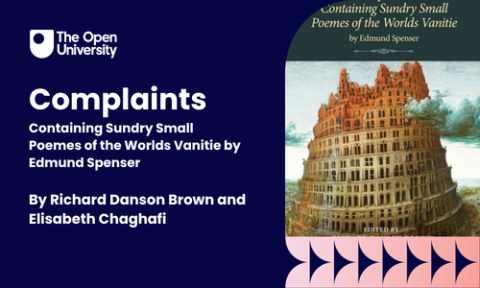
Richard Danson Brown (English & Creative Writing) has co-edited a new edition of Edmund Spenser’s most important and controversial works. Published the year after the first instalment of The Faerie Queene, Complaints (1591) is Edmund Spenser’s most controversial publication. Mother Hubberds Tale, the longest poem in the collection, was suppressed months after its first publication due to its perceived attack on William Cecil, Lord Burghley, Elizabeth I’s Lord Treasurer. Elsewhere in the volume, established political and social hierarchies are repeatedly challenged and overthrown. The Ruines of Time records the wreckage of civilizations and aristocratic lineages. The Teares of the Muses suggests that in neglecting their role as patrons of poetry, the nobility have brought about a decline of learning. Visions of the Worlds Vanitie inverts traditional images of authority as they undermined by seemingly insignificant opponents.
This edition breaks new ground in the framing of these poems as central to Spenser’s achievement. The introduction presents complaint as an open mode, liable as much to subversion as to quiescence. It explores the relationship between early printed editions and manuscript copies of the poems, which proliferated after the official censorship of Mother Hubberd. The edition situates the poems as key texts in the dissemination of Spenser’s poetry into Elizabethan literary circles. In the case of Virgils Gnat, a translation of the pseudo-Virgilian Culex, it provides an unrivalled reassessment of Spenser as a translator through Syrithe Pugh's new annotated translation of the Latin original, thus revitalizing our sense of the volume as a contribution to Elizabethan Classicism. Finally, through the inclusion of the formal lament, Daphnaïda, printed at the same time as Complaints, the edition highlights Spenser’s continued experiment with complaint.
This edition was co-edited by Professor Richard Danson Brown of FASS with Dr Elisabeth Chaghafi of the University of Tübingen, with key contributions from Dr Syrithe Pugh (University of Aberdeen). For Richard, this work represented a return to the beginning of his career as a scholar, since his PhD was on Spenser’s Complaints, which became his first monograph, The New Poet: Novelty and Tradition in Spenser’s Complaints (1999). At the same time, the critical scholarship around Spenser has shifted during those years, and the edition represents a wholly new look at this fascinating collection. In recent years, Richard has been particularly fascinated by the self-conscious aspects of Spenserian complaint, and the ways in which Spenser kept recurring to this unstable mode throughout his work.
Related reading
- “Looke backe, who list”: Reassessing the 1611 Folio Text of Complaints
- Why at all Complain? "Bad" Poetry and Denatured Form in Spenser's Daphnaida
- Complaint, Anger, and Poetic Form in the Tristram Episode of The Faerie Queene
Request your prospectus

Explore our qualifications and courses by requesting one of our prospectuses today.
Are you already an OU student?


Explore

Undergraduate
Postgraduate
Policy
-
Follow us on Social media
-


