
"We Are the History": What happens when a community tells its own story
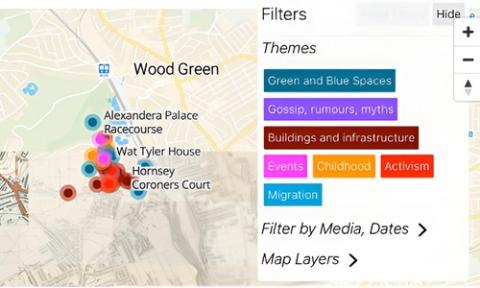
Heritage projects don't usually feature neighbourhoods like Campsbourne Estate. Even though it is home to a strong community spirit and a history of social innovation stretching back over 150 years, with some of the highest levels of deprivation in England, its residents have had precious few opportunities to tell the story of the estate. At least, not until now.
Over the past year, a small but remarkable group of residents from the Campsbourne Community Collective (CCC) have been doing exactly that. Working with researchers from the Pelagios Open Societal Challenge, they have been mapping oral histories, photographs, and personal memories onto an interactive digital map of the estate. This mapping has created a living, community-owned archive of a place that has been largely overlooked by formal history.
The results, captured through interviews and focus groups with project participants, go far beyond what any of them or what the Pelagios team initially expected
"I live here. I'm part of the history"
For many participants, the project began as a simple curiosity about the place they call home. Aiyesha, who took on the role of the project coordinator, admitted she "did not like history at school; didn't like it whatsoever". But documenting the stories of people around her was different: "It's listening to people's stories... having conversations about people, the area they live in, the things they used to get up to when they were younger".
That shift, from history as something done to you, to history as something you find yourself within, was a recurring theme. As Aiyesha put it simply: "I live here, and I'm part of the history".
More than a map
The project's ambitions were to build digital skills and create an inclusive community archive. What nobody fully anticipated was how deeply it would reshape the participants' sense of themselves and each other.
Tony, a music producer who has lived on the estate for decades, described a transformation in how his neighbours see him: "Before, they'd just say hi and bye. I was Tony the music guy. Now I'm Tony the friend". For Sheila, a mental health support worker who moved to the estate in 2013, the weekly sessions became something closer to family: "When I joined this group, it's like I'm back home. In Africa, community is everything... I feel like I belong somewhere".
Another member of the group has already begun applying for jobs in community research; roles she says she'd never have considered before.
What worked, and what needs work
The project also surfaced some hard, honest lessons. The MemoryMapper app, chosen because of its ease of use and for making heritage visually accessible, nevertheless presented various technical challenges, particularly for participants who don't use computers regularly. Even having a stable Wi-Fi connection wasn't something that could be taken for granted. Participants are clear about what is needed: more structure, better facilities, and sustained funding (however little) are essential to keeping this work alive.
Perhaps most powerfully, participants challenged the assumption that experts need to lead community research. "I'm a community leader, no academic background or anything like that; and I was able to do it", said Aiyesha. Budget constraints meant only a small number of community researchers could be paid to participate. Yet, demand from residents to get involved was higher than the project could accommodate. As Aiyesha noted: "There are lots more of us within the community who couldn't be part of it because we were limited on the number of people". In fact, the original five community-researchers agreed to accept half of their allocated budget so that twice as many researchers could participate, but many more might have joined. This raises an important question for funders: What might be possible with just a little more resource directed to the people who know their communities best?
What comes next
The community's hope is to link the Campsbourne MemoryMap to the local Primary School, so that children who recognise the faces and places on the map (including former members of staff, who have been part of the community for over 40 years) can continue adding to it for generations to come. Partnerships with Alexandra Palace, who have already invited the project to showcase at the London Architectural Festival, Bruce Castle Museum, and Hornsey Historical Society, are extending the project's reach well beyond the estate.
This project is early evidence that when communities are trusted to curate their own heritage (given the tools, the training, and the space), what they build is not just an archive. It's a foundation for confidence, connection, and change.
Request your prospectus

Explore our qualifications and courses by requesting one of our prospectuses today.
Are you already an OU student?


Explore

Undergraduate
Postgraduate
Policy
-
Follow us on Social media
-


