
Research in Religious Studies
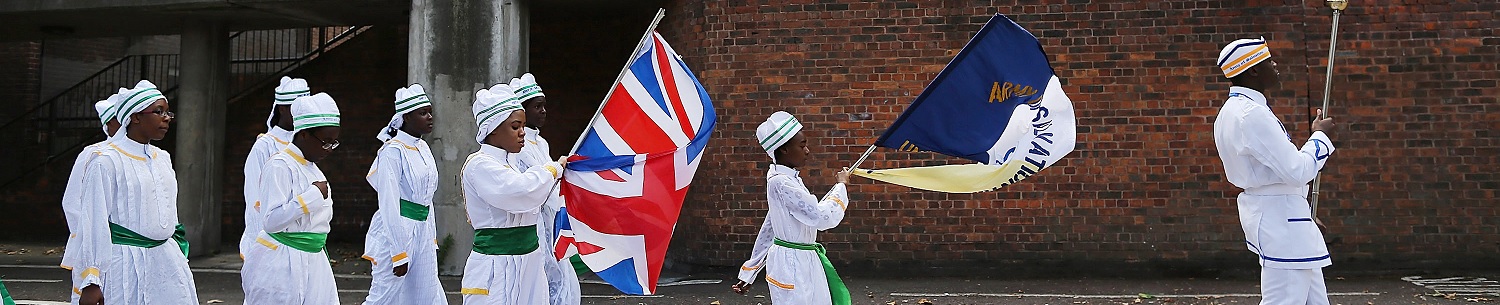
Our research centres around the lived realities of religions and their intersections with the global challenges that impact societies, politics, geographies and cultures. Our staff have a wide range of expertise, working across disciplines including history, anthropology, folklore studies, sociology and critical theory, but with a common focus on contemporary religion in historical perspective.
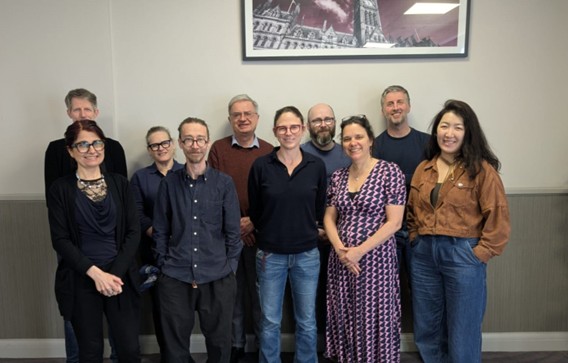
From top left: Paul-François Tremlett, Katelin Teller, John Wolffe, Chris Cotter, John Maiden, Maria Nita, David Robertson, Suzanne Newcombe, Stefanie Sinclair, Liudmila Nikanorova, 2025. Photo credit: David Robertson.
Engaging the wider world
Beyond academia, we have established relationships with a range of secular and religious organisations and groups, including: Bath Interfaith, the Milton Keynes Interfaith network, the Foreign and Commonwealth Office, Glastonbury Pilgrim Reception Centre, the New Testament Church of God, the Northampton Theological Society, the Panacea Trust, the Bear Tribe, and the Religious Archives Group.
We are committed to promoting religious literacy of various kinds. Our FutureLearn MOOC, Why Religion Matters: Religious Literacy, Culture and Diversity, was developed to help policy makers and anyone concerned with contemporary religious developments. Suzanne Newcombe is Honorary Director of Inform, an organisation which advises government and media on minority religious groups, while John Wolffe is a trustee of Faith in Media, which promotes religious literacy in journalism. We contributed evidence to the All-Party Parliamentary Group on Religious Education's report Improving Religious Literacy (2016) and to its inquiry into religious literacy in print and broadcast media (2020).
How we work with others
We recognise the importance of collaboration within our discipline. We believe in nurturing existing partnerships and developing new ones to undertake world-class and innovative research. We lead and participate in various national and international scholarly associations, including the British Association for the Study of Religions, European Association for the Study of Religions, Theology and Religious Studies UK, Ecclesiastical History Society, the Religious Studies Project and the Folklore Society. We have established strong collaborative links in the UK and beyond. Some examples of current collaborations are noted further down the page. Our postgraduate (PhD) researchers can benefit from our participation in the Open-Oxford-Cambridge Doctoral Training Programme.
Our publications
We have several widely respected publications that unpack cutting-edge issues and help advance the debate with innovative ideas and approaches. We believe research should be accessible to as many people as possible – you can read some of our publications for free via publishers’ websites and via The Open University’s Open Research Online collection. Our academics and research degree students are on the editorial boards of multiple peer-reviewed journals. In addition, they contribute editorially towards several books and journals, some of which are listed below:
Religion and the Senses (Equinox)
Religions in Focus (Routledge)
Religion, Space and Place (Bloomsbury)
Religion at the Boundaries (Bloomsbury)
Vitality of Indigenous Religions (Routledge)
Journal of Yoga Studies (online open-access)
Implicit Religion: European Journal of the Critical Study of Religion (Equinox)
Culture and Religion (Routledge)
Religions of South Asia (Equinox)
Sibirica (Berghahn)
Indigenous Religious Traditions (Equinox)
Religious Studies Project
Current projects
Democracy, Disinformation and Religion (DDR)
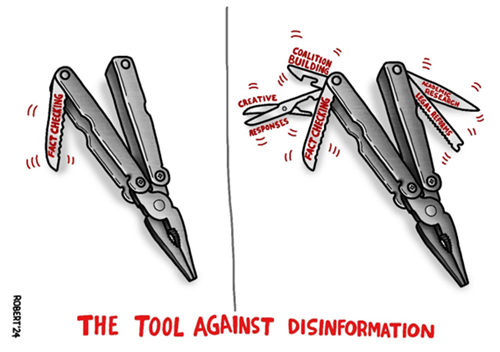
Democracy, Disinformation and Religion is a best practice network of academics, journalists, artists, civil society actors, religious organisations, policymaking and counter-disinformation professionals from across the globe. It promotes cross-disciplinary research on religious organisations as (dis)information actors, and creative methods of knowledge exchange with different communities.
RETOPEA | Religious Toleration and Peace
We live in a largely secular society, yet as religious issues and identity debates continue to surface, religious symbols abound. RETOPEA began as a 2.4 million euro EU-funded international research project investigating the ways in which religious coexistence is considered in different environments. It explores how religion has been managed in peace treaties in the past, and aims to use the insights gained to inform thinking about present-day peaceful religious co-existence, especially among young people. Drawing on historical research and work in schools and youth clubs, RETOPEA seeks to support young people’s active and critical engagement with religious history. Through the creative process of making short documentary films (‘docutubes’), young people explore, discuss and reflect on issues relevant to religious toleration and peace, drawing both on historical exemplars and their own experience.
New Religiosity and the Digital Study of Eudaimonia

The project examines how contemporary religious beliefs and practices influence well-being and human flourishing. It will explore positive aspects of faith communities—like gratitude practices and social support networks—and potentially harmful elements. The project will create a comprehensive framework to analyse 400 global religious movements from the 1970s onwards. It will use cutting-edge digital humanities approaches – integrating qualitative and quantitative analysis – to transform our understanding of religion's role in creating meaningful lives.
The Open University's Religious Studies Department is leading on this innovative £1.2m research project generously funded by the John Templeton Foundation (Grant No. #63357) working closely with the University of British Columbia's Database of Religious History and the educational charity Inform, based at King’s College London. More information is on the project website.
Find out more
Discover more about what we do via our departmental blog and on social media: Bluesky (@religiousstudiesou.bsky.social), X (@religion_ou), Facebook (@religionou), and Instagram (@ou_religious_studies).
Request your prospectus

Explore our qualifications and courses by requesting one of our prospectuses today.
Are you already an OU student?


Explore

Undergraduate
Postgraduate
Policy
-
Follow us on Social media
-


